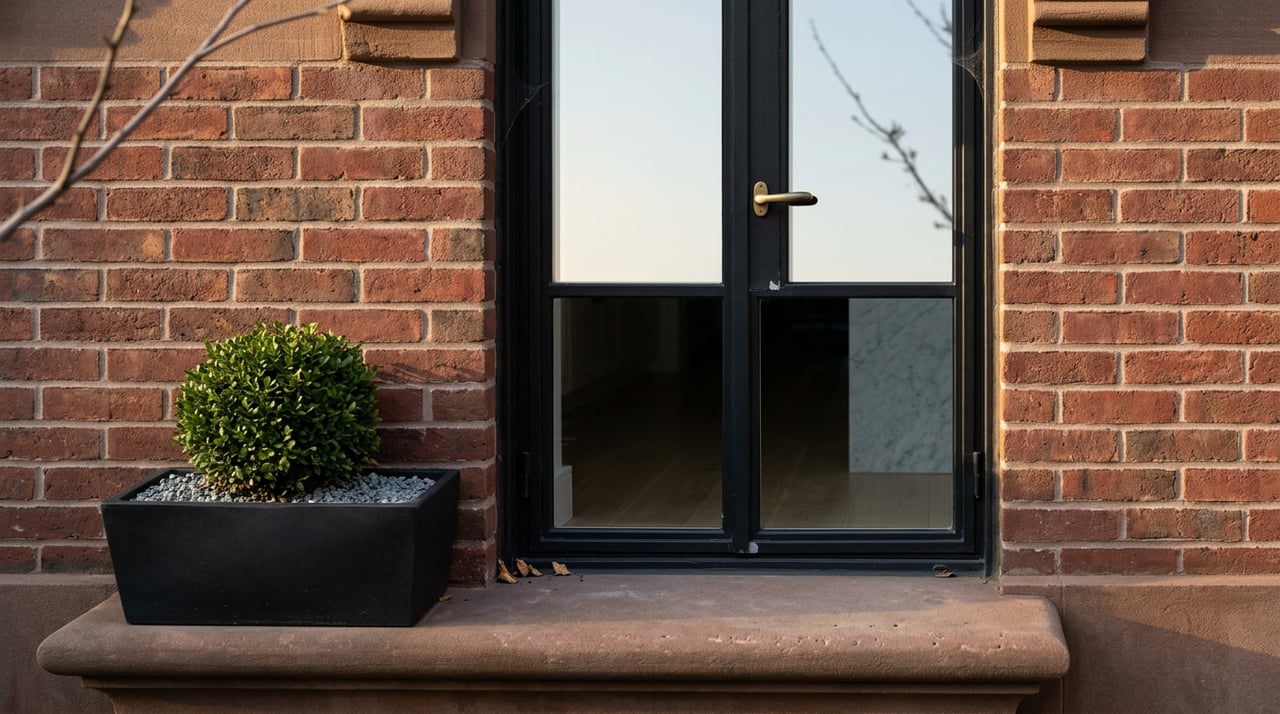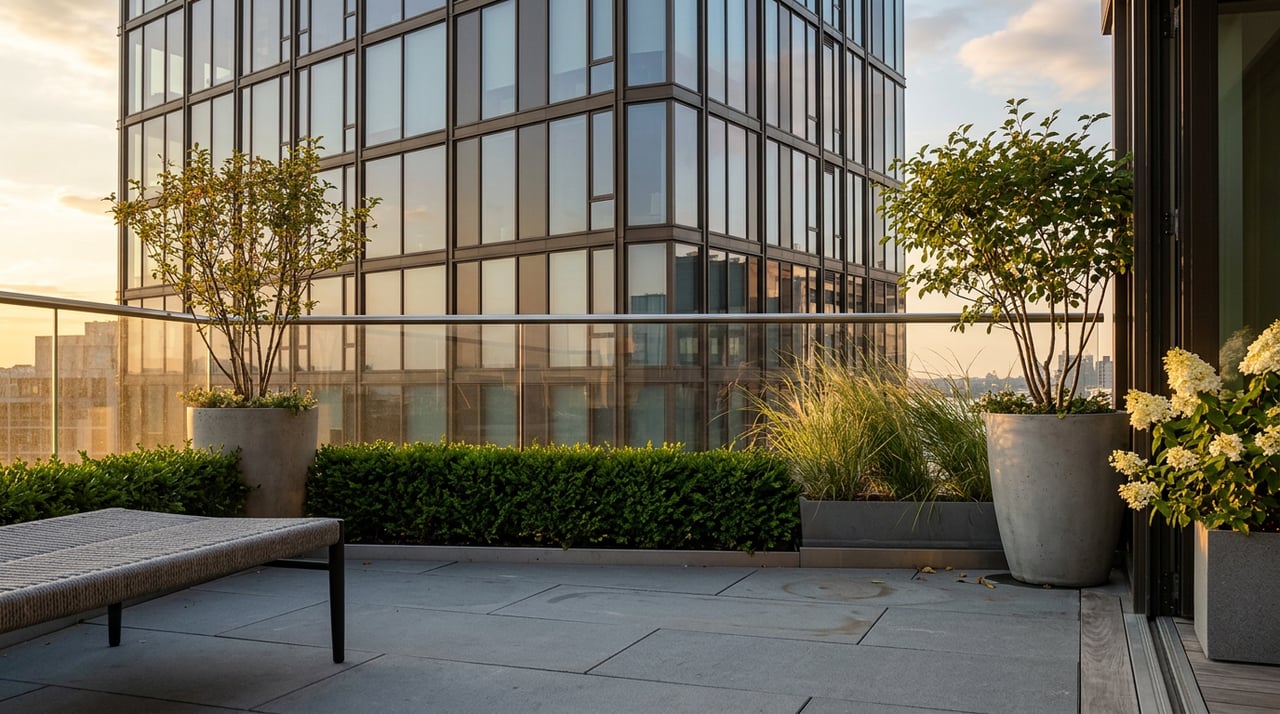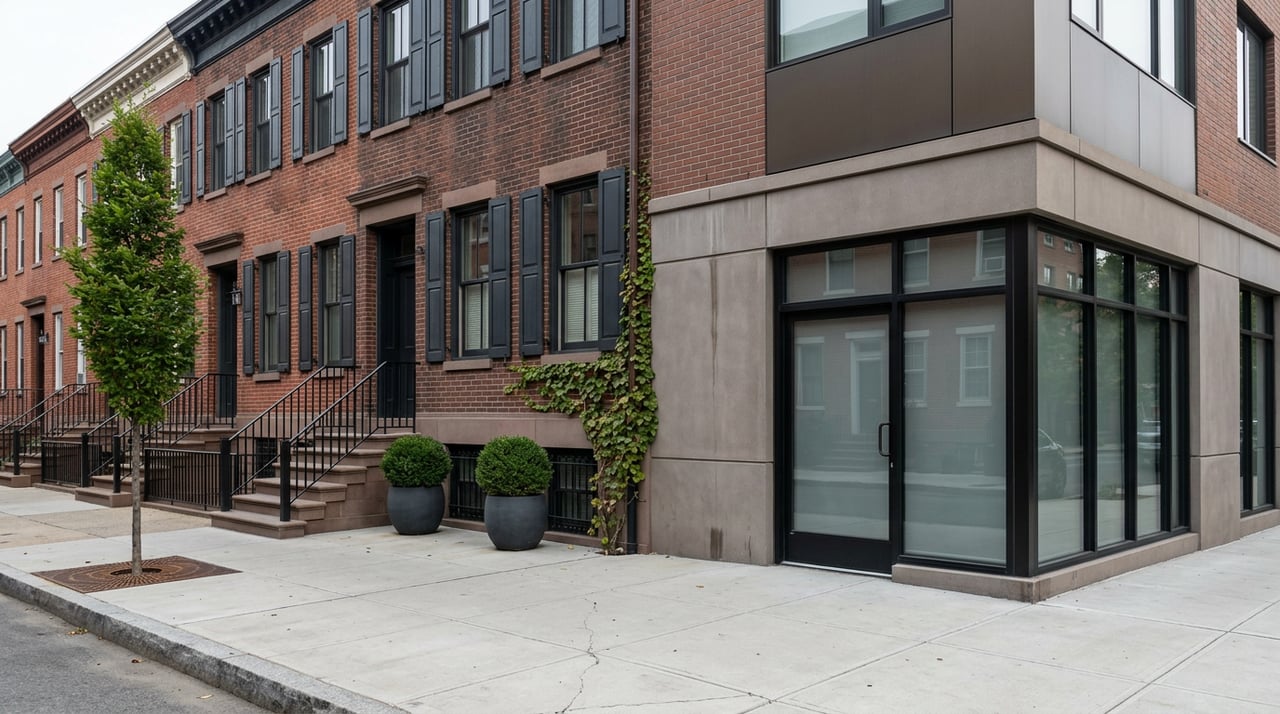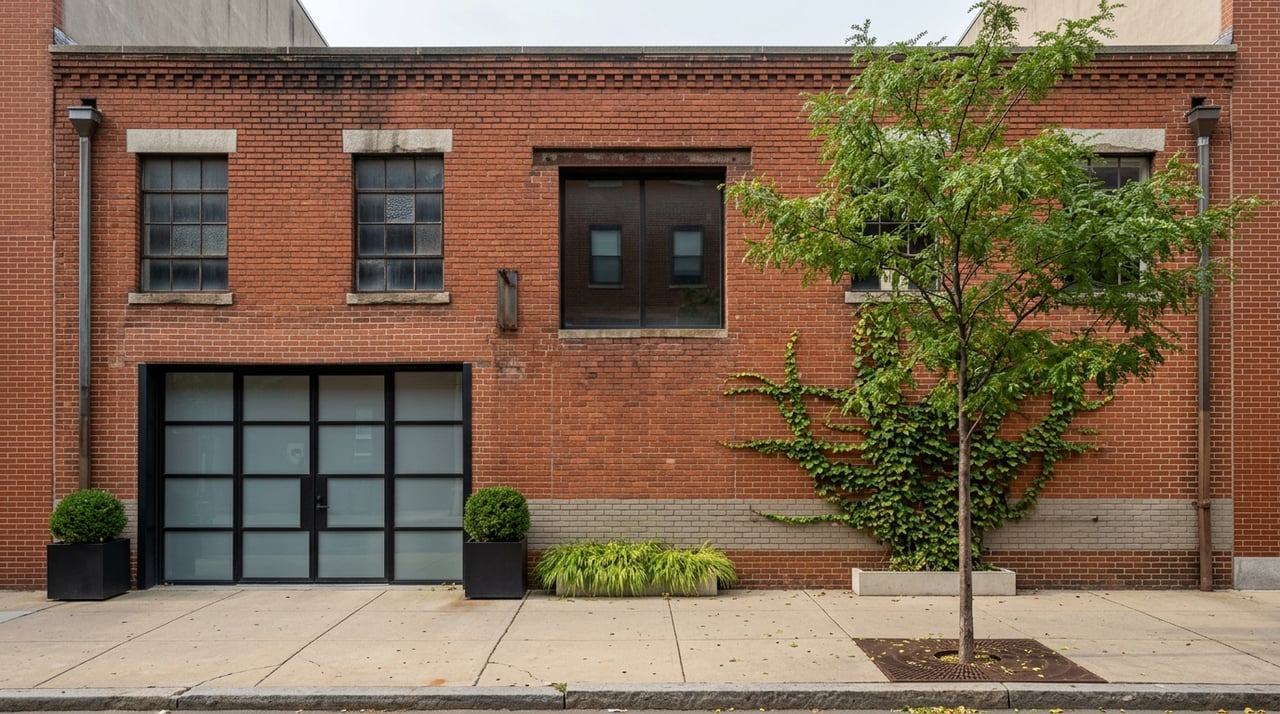
Walk Bay Street from Warren to Greene on a weekday morning and you pass two buildings with the same word in their name and almost nothing else in common. At 124-134 Bay Street, the old A&P Tea Company warehouse has clean brick, a lobby with real foot traffic, and delivery vans dropping off gym mats and taco supplies before nine. A block and a half away, at Greene and Bay, the building the whole district is actually named for sits behind a fence, its smokestacks gone, several of the surrounding roads still closed while the city works out what to do with it.
Most people who live here already know both buildings exist. What's easy to miss is that they are telling two different stories about the same twenty-two years since the district's founding plan, and this fall is the first time both stories are moving at once.
A plan that sat mostly still since 2004
The Powerhouse Arts District got its name and its boundaries from a city redevelopment plan adopted in 2004, with the goal of turning eight blocks of emptied-out industrial warehouses into a working arts district: galleries, studios, affordable loft space for the artists who'd already started moving in because the buildings were cheap and the ceilings were tall. It didn't happen that way. Most of the retail and gallery space that was supposed to fill in over the following decade never found tenants, and the district's physical footprint stayed close to what it looked like when the boundaries were first drawn in 2002, according to its own Wikipedia entry. The city eventually approved zoning for a high-rise on First Street that broke from the original plan, and other blocks got rezoned the same way. The arts district kept its name. It mostly stopped being built as one.
For a long stretch, the neighborhood's identity ran ahead of its inventory. You could point to White Eagle Hall on Newark Avenue a few blocks off and say the creative energy was real. But the district's own core, the warehouse blocks the plan was actually written for, stayed largely frozen.
The one building that did get finished, and who moved in
That changed for one specific structure: the 1913 A&P Tea Company warehouse at 124-134 Bay Street, redeveloped by KABR Group and Kushner with GRO Architects handling the restoration work, now doing business as the Arts & Powerhouse Building. The renovation wrapped in February 2024, delivering more than 100,000 square feet of office and retail space. In late 2025, the Jersey City Landmarks Conservancy gave the project its Adaptive Reuse Award at that year's Save the Powerhouse Preservation Awards ceremony, marking the Conservancy's 26th year of work in the neighborhood. KABR's Michael Goldstein credited the project with "balancing innovation with heritage in urban development."
What's actually filled that building tells you something the redevelopment plan's authors didn't predict. It isn't artist studios. Daily Provisions, the all-day counter-service concept from Danny Meyer's Union Square Hospitality Group, opened its ground-floor space in March 2025. Tacombi, the Mexican spot that started as a taco stand in a VW bus on a Yucatan beach, is in as well. Rumble Boxing, One Medical, and Spear Physical Therapy all signed on for the ground floor. Han Dynasty, the well-regarded Philadelphia import, was finishing build-out as of last fall. And on August 4 of this year, Jersey City Times reported that Hudson Golf, the Hoboken indoor golf and bar concept, is opening its second location in the building, at the corner of 1st and Warren. Hudson Golf's own site confirms the build is underway, with the second location expected later this year. A source told Hoboken Girl that Chelsea Piers is also eyeing roughly 60,000 square feet in the building for a fitness club with a rooftop pool, though Chelsea Piers hasn't confirmed it directly.
So the building the arts district was drafted around is now, in practice, a wellness and hospitality corridor. That's not a knock on it. It means the neighborhood's one fully realized adaptive-reuse project is doing real work, drawing foot traffic and daily errands back into a block that sat quiet for two decades. It just isn't the version of "arts district" the 2004 plan pictured.
The building the name actually belongs to
Here's where the confusion sets in for a lot of people, including some who've lived here for years: the Arts & Powerhouse Building is not the Powerhouse. The actual landmark, the Hudson and Manhattan Railroad's Victorian-era generating station at Greene and Bay, is the structure that gave the whole district its name, and it is still owned in part by the Port Authority of New York and New Jersey, which is in the process of deeding its 55 percent stake to the Jersey City Redevelopment Agency. The JCRA's stabilization work, which included removing the building's deteriorated smokestacks, has left several roads around the property closed for the foreseeable future.
The nonprofit fighting to save that specific building, the Jersey City Landmarks Conservancy, was organized in 1999 and describes its campaign as one now in its 27th year, still up against "the unstoppable pace of development" pressing in around a structure that's waited longer than almost anything else in the district.
How to actually see the difference for yourself
The Conservancy runs walking tours that make this contrast concrete rather than abstract. An April tour this year started at the Grove Street PATH station and ended at the Powerhouse itself, letting attendees walk the distance between the district's transit anchor and its stalled landmark. On August 22, the Conservancy is running two more tours, one from 10:30 to 12:30 meeting at Sable and a second from 1:00 to 3:00 meeting at Haus25, both led by architectural historians and built around what the Conservancy calls a 200-year-old industrial landscape reinvented for daily use. The tours are organized in partnership with the Powerhouse Arts District Neighborhood Association, whose president, Kathryn Moore, has been credited by the Conservancy as central to keeping the district's preservation efforts moving.
That two of the four named meeting points across this year's tours are neighborhood bars rather than landmarks or plazas is its own small signal. The tours are routing through the businesses that actually opened.
A festival that didn't exist a year ago
The clearest evidence that outside institutions are now treating this district as a real cultural destination, not just a name on a map, is the Jersey City Music & Arts Festival. It's brand new this year: a free, ten-day festival produced by the New Jersey Symphony, running September 24 through October 3 and centered in the Powerhouse Arts District. The Symphony's own musicians will perform alongside local groups including Nimbus Dance, Riverview Jazz, and Kulture Kool. A dedicated Kids Day on September 26 will bring a Bollywood dance celebration, hands-on orchestra instrument demonstrations, appearances from a group called Zombie Opera, and the Jersey City Free Public Library's bookmobile.
That's a different kind of institutional bet than a redevelopment plan drafted more than two decades ago. It's an established regional arts organization choosing this specific stretch of blocks, this year, as worth building a recurring event around.
What actually changed
None of this looks like the arts district that got platted in 2004. There's no wave of subsidized studio space, no gallery row. What exists instead is a restored warehouse full of national fitness and hospitality brands, a preservation nonprofit still fighting for the one building that carries the district's actual name, and an outside orchestra choosing this footprint for its first major public festival. The plan didn't fail so much as it got answered by different players than the ones it was written for.
If you live in the district, the practical version of all this is simple. The building at 124-134 Bay Street is worth checking on every few months, because it's still adding tenants. The actual Powerhouse landmark is worth watching for different reasons entirely, since its fate depends on an agency transfer that's still in progress. And the last weekend of September is worth keeping open.
If you're weighing what any of this means for property values or timing on the block you live on or one nearby, that's the kind of question Hudson Realty Group fields regularly for buyers and sellers across the district and the rest of Downtown Jersey City. You can find our full neighborhood breakdown on the Powerhouse Arts District page, and reach out any time you want a local read on how a specific block is trending.